

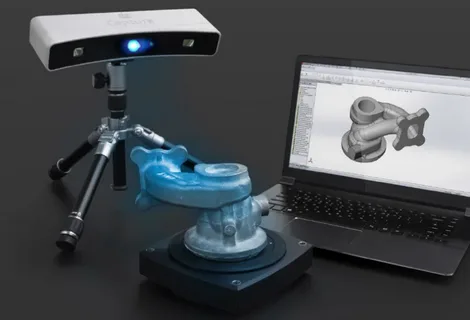
In recent years, 3d scanning has emerged as a game-changing technology, particularly in the realm of sustainability and environmental conservation. Its ability to capture highly accurate and detailed digital representations of physical objects and spaces is transforming how projects related to the environment and sustainability are executed. By reducing waste, enhancing resource efficiency, and improving project outcomes, 3D scanning is proving to be a key tool in driving sustainability. In this article, we explore the environmental benefits of 3D scanning in sustainability projects, and how it is helping industries make a positive impact on the environment.
What is 3D Scanning?
3D scanning is a process that uses laser or other scanning technology to capture precise measurements of an object or space. This data is then used to create detailed digital models that can be analyzed, altered, or used for further design and development. In sustainability projects, 3D scanning plays an essential role in creating accurate digital twins of real-world objects, environments, or structures.
Reducing Material Waste and Resource Consumption
One of the most significant environmental benefits of 3D scanning in sustainability projects is its potential to minimize waste. Traditional construction and manufacturing processes often result in excess material use and significant waste, as measurements are taken manually and materials are cut based on estimates. With 3D scanning, however, the precise data captured ensures that only the required amount of material is used.
In construction and architecture, for example, 3D scanning allows for the creation of precise digital blueprints and models, enabling builders to order materials with high accuracy. This reduces material waste significantly, contributing to a more sustainable and resource-efficient process. The technology is also valuable in retrofitting projects, where existing buildings can be scanned to create accurate models for renovation, rather than demolishing and rebuilding structures, which further conserves resources.
Improving Energy Efficiency in Building and Infrastructure Projects
The environmental benefits of 3D scanning extend into energy efficiency, particularly in the design and construction of buildings and infrastructure. When combined with building information modeling (BIM) or other design software, 3D scanning allows architects and engineers to optimize designs for energy use.
For example, 3D scanning can help identify areas in a building or structure where energy loss might occur—whether through gaps, inefficiencies in insulation, or issues with HVAC systems. By addressing these inefficiencies in the design phase, energy consumption can be minimized, leading to more eco-friendly, energy-efficient buildings. This not only helps reduce the carbon footprint of a project but also reduces long-term operating costs for the building owners.
Enabling Better Resource Management and Conservation
In many sustainability projects, particularly those related to natural resources or wildlife conservation, accurate and real-time data is critical. 3D scanning technology allows for the precise mapping of ecosystems, habitats, and natural features without the need for extensive physical interventions that can disrupt these environments.
For example, in forestry management, 3D scanning can be used to monitor tree growth, assess biodiversity, and understand the impact of environmental changes on forest ecosystems. Similarly, in oceanography, 3D scanning is used to map underwater landscapes and monitor coral reefs, giving scientists valuable insights into marine environments without disturbing delicate ecosystems. By reducing the need for traditional, disruptive data-gathering methods, 3D scanning helps promote sustainable practices in the conservation of natural resources.
Enhancing Circular Economy Practices
The principles of a circular economy—reducing waste, reusing materials, and recycling—are becoming central to many sustainability initiatives. 3D scanning plays a vital role in supporting circular economy practices by enabling efficient material recovery and reuse.
In industries like manufacturing, 3D scanning allows for the digitalization of parts and products, making it easier to assess their condition, quality, and potential for reuse or recycling. For example, when machinery or equipment reaches the end of its useful life, 3D scans of the components can be used to design replacement parts, reducing the need for entirely new materials. This encourages the reuse of components, minimizes waste, and supports a more sustainable manufacturing process.
Conclusion
The environmental benefits of 3D scanning in sustainability projects are far-reaching. By reducing material waste, improving energy efficiency, supporting better resource management, and promoting circular economy practices, 3D scanning is playing a critical role in advancing environmental sustainability across various industries. As technology continues to evolve, its applications in sustainability projects will only expand, further helping to minimize our environmental footprint while promoting the efficient use of resources.
