

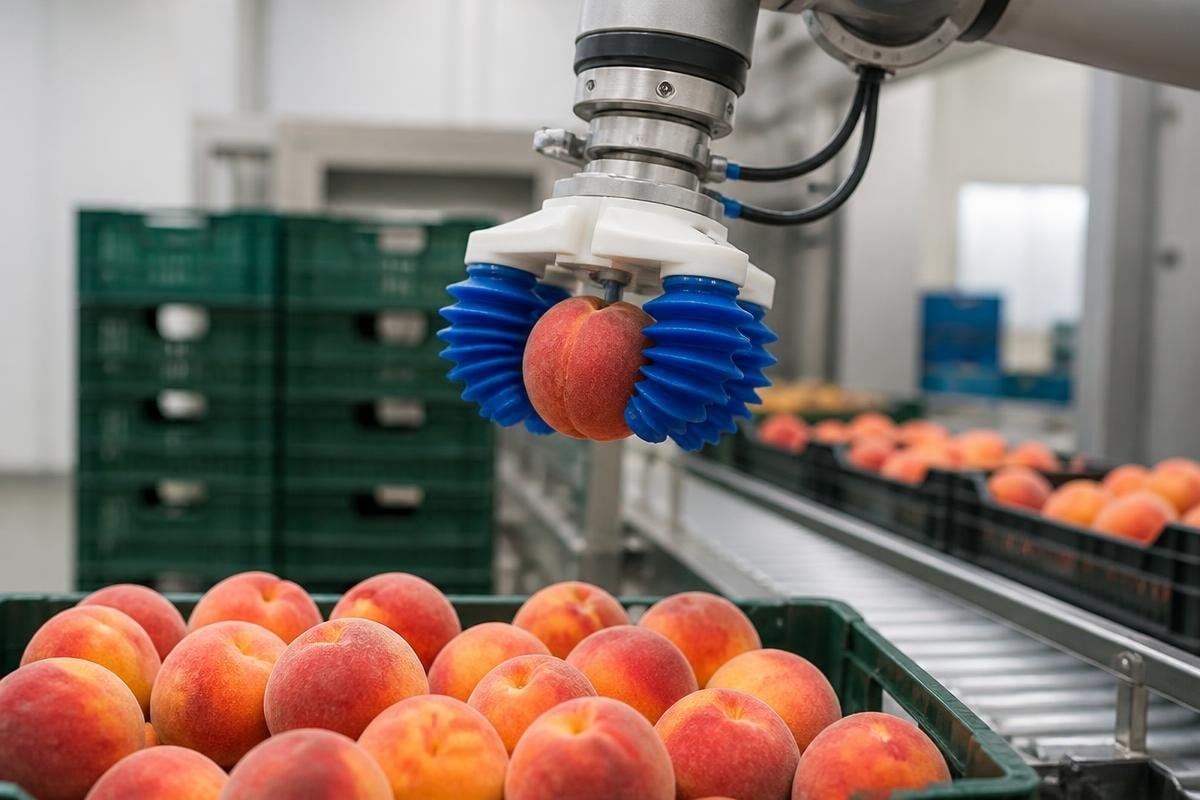
A ripe peach can be damaged by a gripper that handles a plastic box with no trouble. Soft robotics gives food automation a way to hold items with less force and more contact, which matters when appearance affects what gets sold.
Quick read
- Soft grippers spread pressure across a larger area.
- Flexible fingers can fit produce with different shapes and sizes.
- The hard part is repeatable handling at the speed a packing line needs.
Where rigid grippers fall short
Rigid grippers work well when an item has a firm surface and a known shape. A carton, tray, or metal part can take a strong clamp without changing form, so the robot can use fixed positions and repeat the same motion.
Produce behaves differently. A tomato may be soft on one side, a pear may vary in width, and a peach can bruise under pressure that leaves no visible mark at first. The robot needs to hold the item long enough to move it, then release it without tearing the skin or dropping it.
That makes force control as important as position. A gripper that reaches the right place can still damage the crop if its fingers close too far or move across the surface.
How soft grippers handle produce
Soft robotic grippers use flexible materials that change shape as they close. Some use air pressure to bend silicone fingers. Others use cables, small motors, or flexible joints to wrap around an item.
The useful change is contact. Instead of pressing with a few hard edges, a soft finger can touch a wider area and spread the load. That lowers pressure at any one point, provided the gripper has been set up for the produce it handles.
The fingers still need enough grip to stop slipping. Surface texture, moisture, weight, and ripeness all affect that job. A gripper tuned for dry apples may need a different shape or force setting for wet leafy vegetables.
Soft materials also forgive small errors in position. If the robot approaches a fruit slightly off-centre, the fingers can bend around it rather than pushing against one spot. That helps with natural variation, though it doesn’t remove the need for sensors and careful control.
The trade-off on a packing line
Gentle handling matters only if the line can keep working at a useful rate. A soft gripper may need slower closing, lower acceleration, or a pause to check that the item is secure. Those steps can reduce damage, but they also affect the number of items handled in a shift.
Cleaning adds another test. Food equipment faces water, plant residue, and repeated washdown. The gripper must keep its shape, avoid trapping dirt, and allow workers to inspect or replace worn parts. A flexible material that works well in a demo may need changes before it suits daily cleaning.
The control system has to deal with variation too. Cameras can help find each item, while force or pressure sensing can show whether the grip is too weak or too strong.
For produce automation, a useful report names the crop, gripper, handling rate, and damage result. Robot24.com can help you compare a soft gripper’s promise with what happened on a farm or packing line.
Soft robotics also has a clear limit: a flexible finger doesn’t know when produce is ripe. That decision needs a camera, a pressure reading, a trained operator, or another check. The material solves part of the contact problem, not the whole picking task.
A buying checklist for produce automation
Before choosing a soft gripper, check these points against the crop and the line:
- Product range: Measure the smallest and largest items the gripper must hold.
- Contact force: Set a safe force range for the softest produce, then test grip on wet surfaces.
- Release motion: Check that the robot can place items without sliding or dropping them.
- Washdown: Confirm the material, seals, cables, and sensors suit the cleaning process.
- Service parts: Ask how often fingers, skins, seals, or cables need replacement.
- Line speed: Compare the full pick-and-place cycle with the target rate, including pauses.
I’d choose a soft gripper when bruising or skin damage costs more than a slower cycle. For hard produce and fixed loads, a rigid tool may remain the simpler choice.
The next useful proof will be long runs with mixed sizes, changing ripeness, washdown, and measured damage rates. Until those results are published for a specific crop, treat a soft gripper as a promising tool that still needs a line trial.